


Let’s be honest: Trying to keep up with the world in 2025 was an absolute exhaustion, and I can’t even imagine the speed at which we’ll need to catch up with 2026’s AI revolution. We are drowning in content but starving for context.
I remember back in 2023 when we thought “AI summaries” just meant a chatbot reading a generic article to us. Fast forward to today, and the landscape has undergone a complete shift. Every single day since OpenAI released ChatGPT, I’ve been seeing new apps and platforms from people all around the world, and when it comes to news and general content consumption, this is where things also got very interesting.
Can AI replace our traditional ways (e.g., websites or RSS readers)?
When it comes to content consumption, I’ve always relied on RSS Readers. Unfortunately, they were never great, especially considering that, one day, you may have had to switch to an alternative, just because the company behind it decided to ditch it (I’m talking to you guys, Google and Digg). If you were lucky, there was a way to migrate your data automatically and do little to no manual work, or completely rebuild your sources from scratch.
The problem with RSS Readers is that they’ve stayed the same. Sure, you add an RSS feed, organize it in a folder or by using tags, and then let it automatically sync all the articles from your favorite website and pull them right in front of you with a list or grid style. That’s good enough for most people, and it was for me too, but nowadays, I find them kinda outdated, so I wanted to see if artificial intelligence was used well enough to build a true AI-generated news site or RSS Reader.
So I’ve spent the last few months testing every major AI news platform, scrapping my old RSS feeds, and letting the algorithms take the wheel to see if they can actually deliver news.
The 5 Best AI-Powered News Sites & RSS Readers in 2026
Whether you’re a power user who needs to track market shifts or just someone who wants to know if it’s going to rain in Athens without browsing through hundreds of ads, here are the best websites for AI-powered news that I found and been using lately.
1. Particle (The New King)
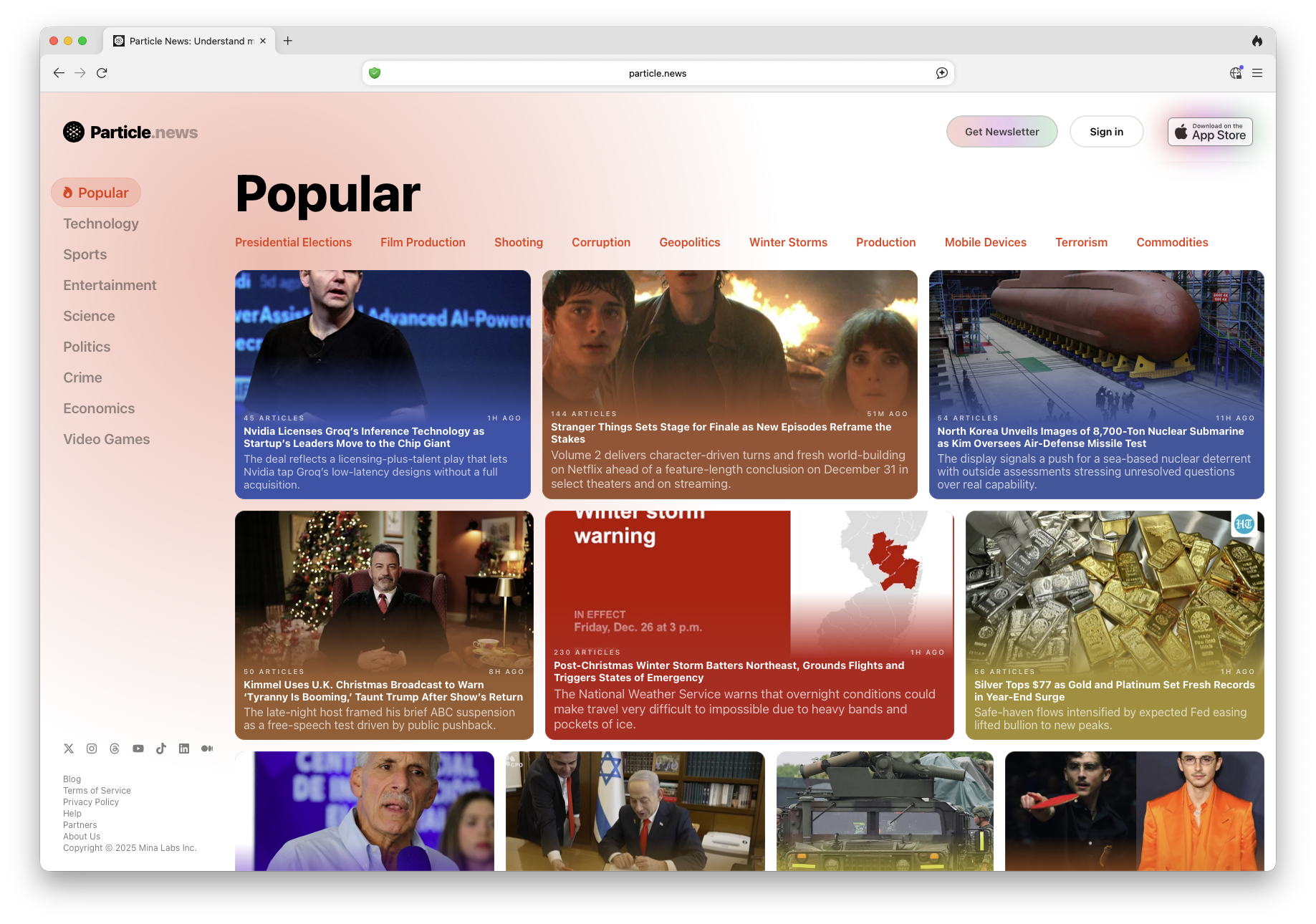
If you asked me two years ago, I wouldn’t have bet on a new standalone app taking the crown, but Particle has genuinely changed my morning routine.
What makes it special isn’t just the summarization, it’s the perspective switching. I love that I can read a story about a new EU tech regulation and instantly toggle a slider to see how the same event is being covered by different sides of the political spectrum.
Why I use it:
- “Explain Like I’m 5”: Sometimes I don’t have the mental energy to parse complex geopolitical jargon. One click, and Particle breaks it down.
- Hallucination Control: They’ve implemented this “Reality Check” feature that highlights claims and links them directly to the source text. It’s the most transparent AI I’ve seen.
- The Ecosystem: It works seamlessly between the mobile app and the web interface.
If you only bookmark one site from this list, make it this one. It feels like the spiritual successor to Artifact, but smarter.
This is arguably the best way to replace Google News and other similar news sites, but not a stronger option if you want to build your own custom feed.
2. Perplexity
I’ve written about Perplexity before, but their updates in late 2025 have pushed them from “search engine” to “research powerhouse.”
Perplexity isn’t where I go for breaking headlines (like “Who won the game last night?”), but it is where I go when I need to understand a developing story. If a new AI model drops, I don’t want a 500-word news clip; I want Perplexity to scan the whitepaper, the Reddit discussions, and the press release, and then synthesize a briefing for me.
The killer feature here is the new “Comet” Assistant. It preserves your context. I can start reading about a topic on my desktop, ask a follow-up question on my phone while grabbing a coffee, and it remembers exactly where we left off.
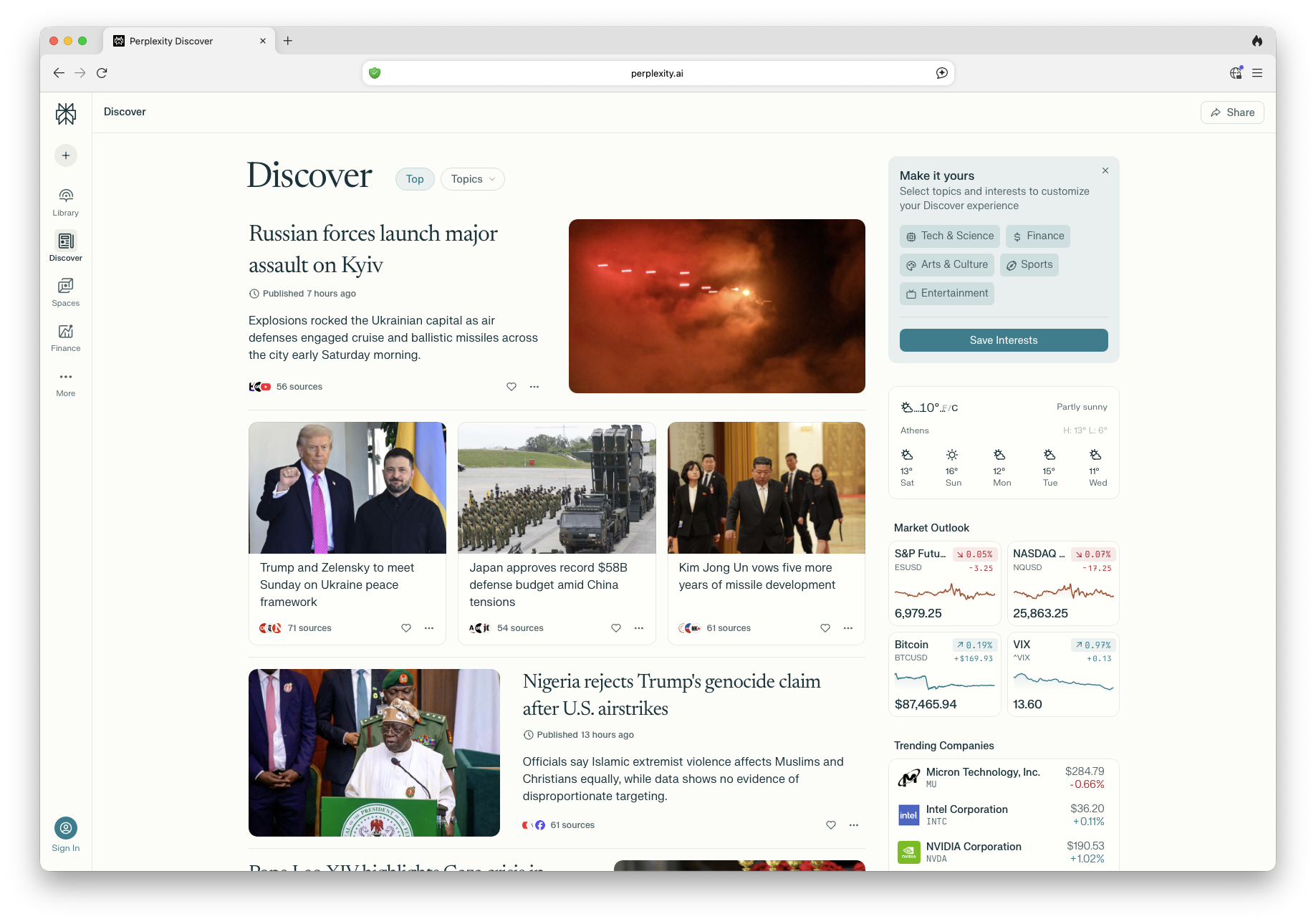
They also introduced the Discover page, where you can find all the latest and most trending news from all around the world, along with all the sources writing about the same topic. There’s also a trending section with the most popular companies right now, how the market outlook looks, a weather widget, and a way to filter the content that you’re seeing with your own interests.
3. Google News
Look, I know many of us have a love-hate relationship with Google, but we can’t ignore the elephant in the server room.
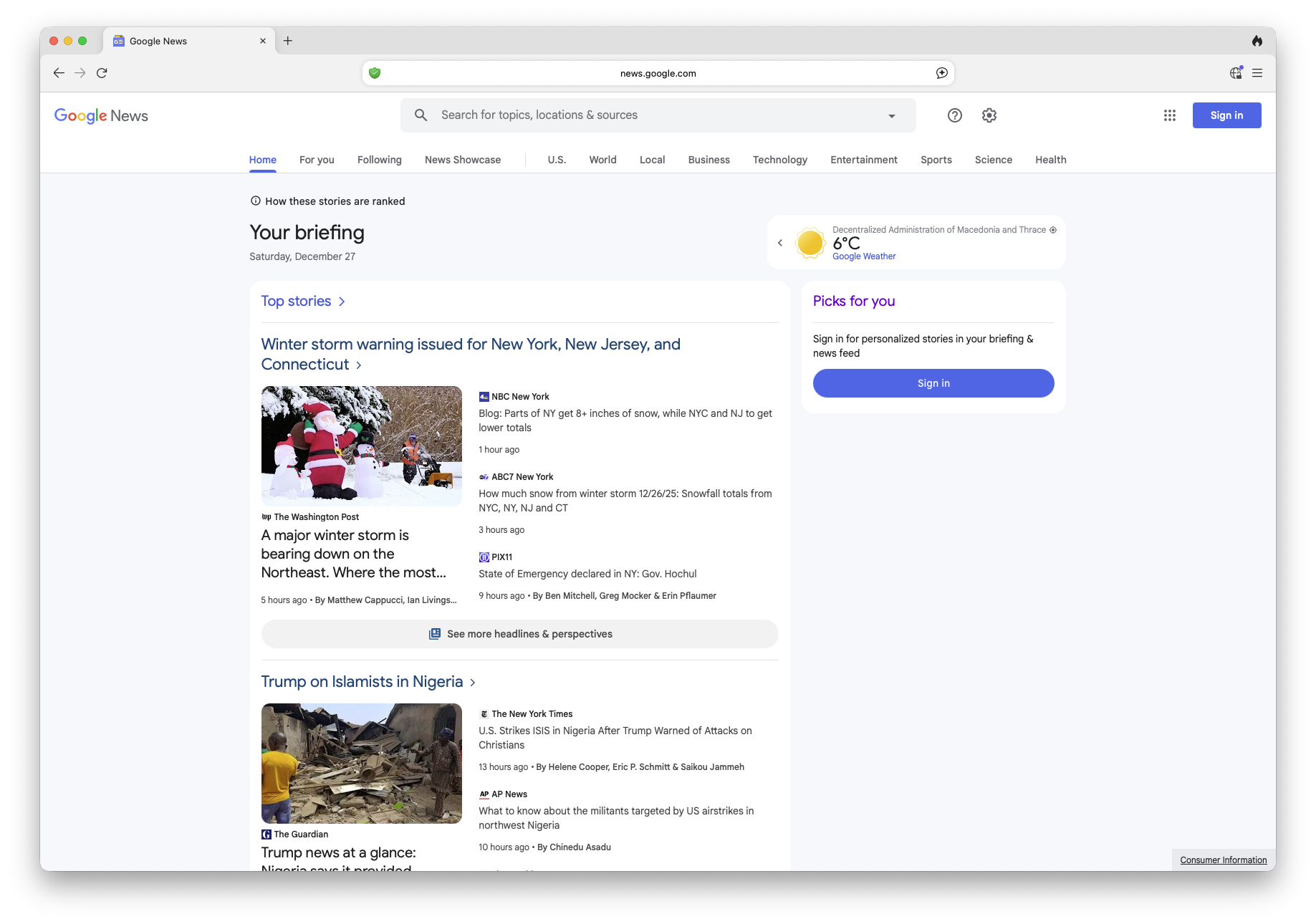
Google News has quietly become a beast in late 2025. They’ve finally integrated Gemini properly. Instead of just a list of links, you now get a dynamic “Briefing” at the top of the page that updates in real-time.
What works:
- Local News: It is still unmatched for local updates. No other AI tool knows my local Greek neighborhood better.
- Fact Check Labels: Google’s “About this image” and deep-fake detection tags are life-savers in an era of AI-generated misinformation.
The Downside: It’s still cluttered. You have to fight through the UI to find the gems, whereas Particle hands them to you on a silver platter. AI content is also everywhere.
4. Feedly + AI Leo (For the Pros)
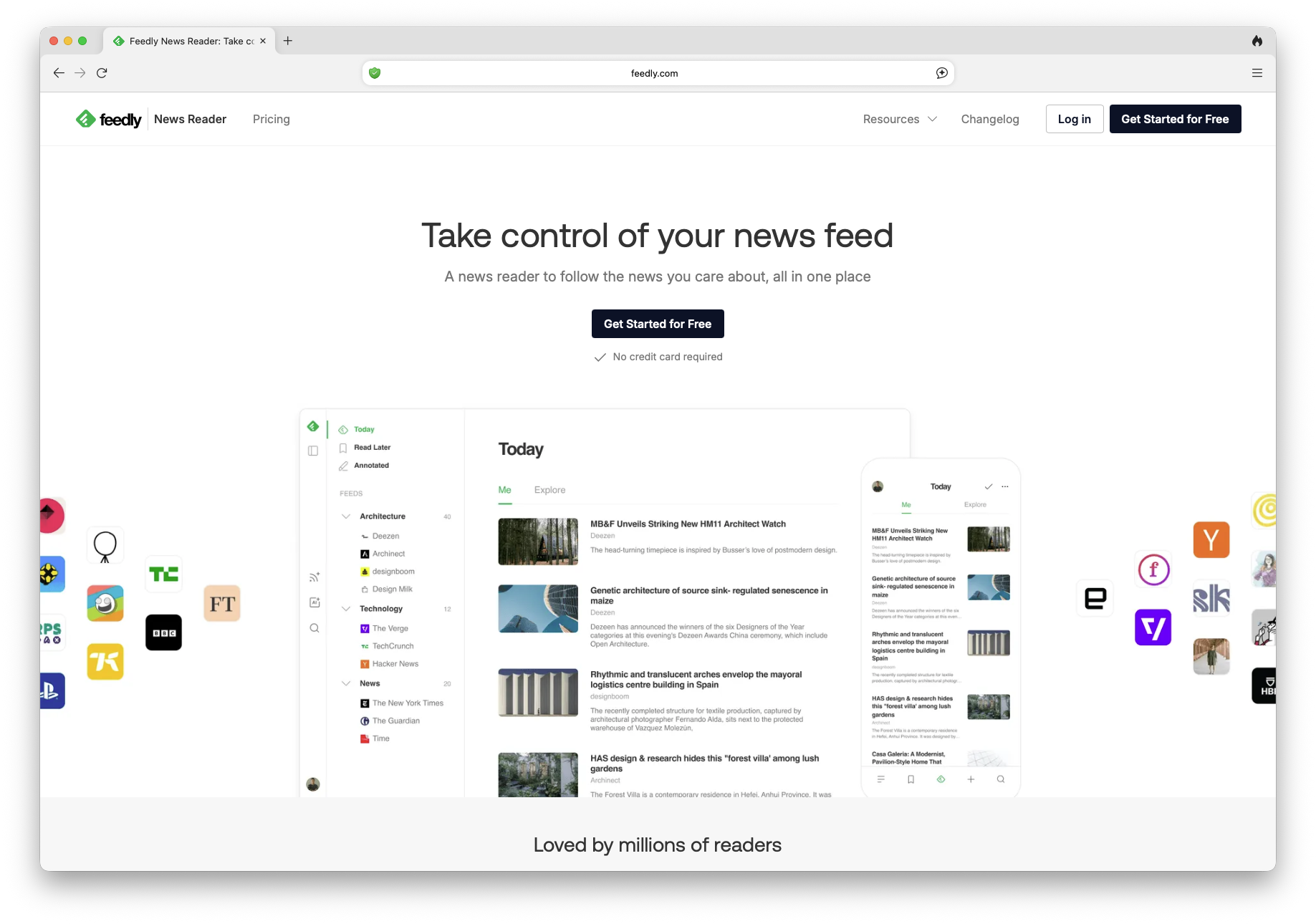
For my fellow SEOs, developers, and content creators, Feedly is still the command center. This isn’t for the casual reader. This is for when you need to track specific keywords across 10,000 sources.
Their “AI Leo” has gotten scary good at noise reduction. I trained Leo to flag any WordPress vulnerability news that affects specific plugins I use, and ignore the rest. It worked like a charm.
Why it makes the list:
- Total Control: You aren’t at the mercy of a “black box” algorithm. You choose the sources; the AI just filters them.
- Summarization Actions: You can set it to auto-summarize articles into bullet points before you even click them.
Unfortunately, your friendly neighborhood Leo comes with a price. You can access the basic features of their AI Leo starting with their cheapest plan that includes it at €8.81 per month (billed annually), and then €12.4 per month (also billed annually).
5. ChatGPT

We can’t talk about late 2025 without mentioning OpenAI. While not a “news site” in the traditional sense, their Search product has effectively replaced the newspaper for millions.
I use this when I want a conversation, not a feed. “Catch me up on what happened with the SpaceX launch this morning.” or “Catch me up with what happened with WordPress in December, 2025”. It’s conversational, fast, and the voice mode is perfect for when you’re driving.
You can also ask ChatGPT to include more sources in its reply, or limit its search and ask it to provide the news from specific sources only, e.g:
"Catch me up on the latest SpaceX launch. Strictly limit your search and citations to The Atlantic, The New York Times, The Verge, and Ars Technica. If you cannot find information on these specific sites, please tell me rather than using other sources."
However, I still double-check the dates (old habits die hard). But reading the news with ChatGPT has completely changed my mind about how I give it prompts. For example, I get specific with the things that I want, and do not let the LLM decide for itself.
If you want more curated results, try the following prompt:
"I want to see how tech-focused media compares to general news on the SpaceX launch. Search for recent articles from The Verge and Ars Technica, and compare their coverage to The New York Times and The Atlantic. What different angles do they take?"
This is a great way, for example, to compare your favorite websites based on how they write an article on the same topic.
You can’t even imagine how many times I’ve completely stopped reading a website just because its content, as it seems, was trying to persuade people on specific things like ideology or their beliefs about something.
Final Thoughts: Which one is for you?
If I had to pick just one workflow for 2026? I’d say:
- Use Particle for your daily “newspaper” replacement.
- Use Perplexity when you need to research a topic deeply.
- Use ChatGPT to compare, analyze, and find more sources.
- Keep Feedly if your job depends on tracking specific industry trends.
The internet is louder than ever, but with the right AI filters, maybe we can fix that. But if you need to go back to traditional ways (not judging), there’s nothing that can easily beat Inoreader or NewsBlur.
Google News is still a solid option, but I guess it has stayed the same and Google doesn’t seem to have it on its plans when it comes to actually integrating user-friendly features. Another huge problem is that the company has now removed the Publisher Center, meaning bloggers and journalists can’t submit their sites to Google News anymore.
What’s your go-to news source these days? Let me know in the comments, I’m genuinely curious if anyone is still visiting individual homepages anymore (which I still do and I’ll keep doing because some are always worth the click).


Great roundup of AI-powered news sources. One site worth adding to the list is Best AI News (https://www.best-ai.news) — it’s a daily digest focused specifically on AI model releases, new tool launches, and research highlights. What sets it apart is the editorial focus on practical relevance: each update explains not just what launched, but why it matters for developers and everyday users. For anyone trying to stay on top of the rapidly changing AI landscape without drowning in noise, it’s become a go-to daily resource.